Watch the normal retrieval
Accessible cookware storage starts with the movement someone actually makes to begin a meal. Notice where frequently used pans are kept, what must be moved first and whether the handle can be reached comfortably. A tidy photograph does not reveal an awkward bend or a heavy stack. Ask the people using the kitchen what feels inconvenient rather than deciding that a symmetrical arrangement is automatically the easiest one for everyone to manage.
Choose one repeated difficulty to address first. It might be a saucepan behind heavy cookware, a lid that tips when the door opens or a pan stored above a comfortable reach. Describe the problem concretely so the change can be evaluated. You do not need a medical label or a universal rule about shelf height to recognise that a particular movement is uncomfortable and another arrangement may make ordinary cooking easier.
Give regular tools priority
Place the most frequently used suitable cookware in accessible stable positions. Less-used pieces can occupy other appropriate spaces if they can still be retrieved securely. Avoid putting a popular light pan beneath a heavy pile simply because the shapes nest neatly. The number of daily movements matters: a small rearrangement repeated before every meal can be more useful than a complete cupboard makeover that mainly improves how the closed storage looks.
Measure the opening and the grip
Check cupboard openings, drawer space and handle clearance with actual cookware rather than rough assumptions. Include the room needed to take hold comfortably and remove the item without twisting it through an awkward gap. A pan can fit on a shelf yet be difficult to retrieve through a narrower door. Keep the arrangement within the storage furniture’s intended load and installation limits rather than relying on improvised supports to create extra space.
Reduce unstable stacking
Use a stable layout that does not require balancing one vessel on a lid knob or pulling an item from beneath an uncertain load. Where nesting is permitted, follow the cookware maker’s surface-protection guidance and keep pieces manageable to separate. Consider whether a smaller collection with clear roles would be easier to use. Removing duplicate tasks from the accessible area can create room without purchasing another organiser that adds complexity to the same crowded cupboard.
Keep lids identifiable
Match lids with their intended vessels using product information where needed. A clear position or label can reduce searching through several similar-looking accessories. Include knobs and handles when planning space, and make sure a lid can be retrieved without dislodging another piece. Do not use an approximate fit as the sole basis for assigning a lid to a pan, especially if the combination might later enter an oven or another cooking stage with specific requirements.
Follow the route through cooking
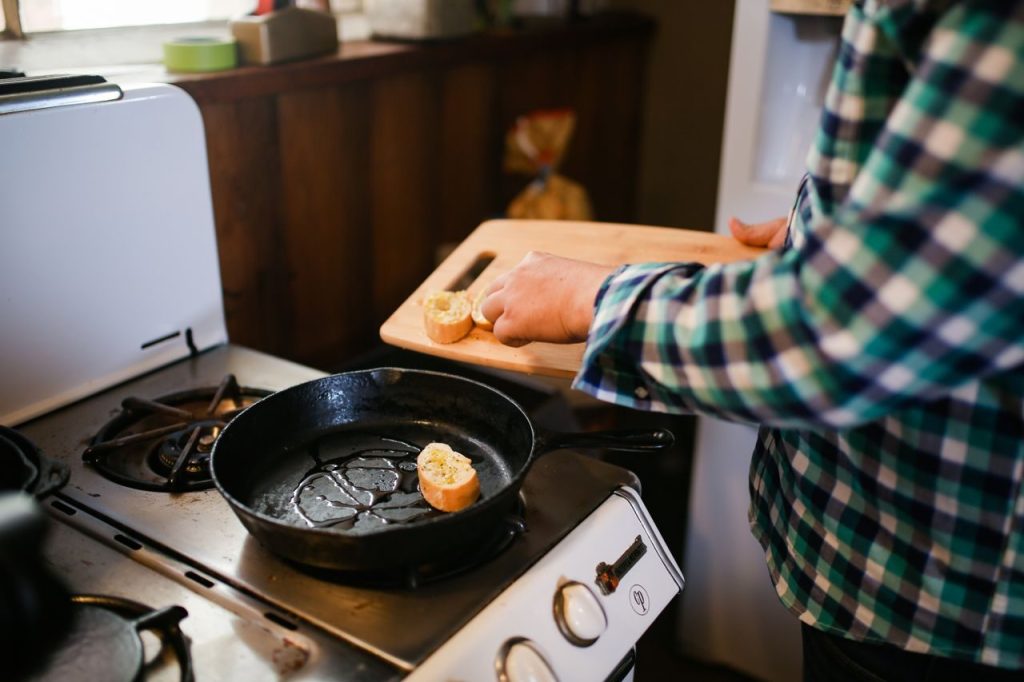
Storage is only the first stage. Identify a clear landing place beside the hob or oven and consider loaded handling when food is added. An accessible cupboard cannot compensate for a serving route that requires carrying a hot heavy vessel farther than necessary. Plan the cooking and serving arrangement together, using appropriate stable surfaces and protection. If a pan remains uncomfortable when loaded, a different size or meal plan may be more suitable than another storage adjustment.
Make the washing return manageable
Check how the pan will be washed, dried and returned to its place. A vessel that needs an awkward reach only after washing still creates a repeated difficulty. Keep compatible cleaning tools available and follow the surface-care instructions. Choose storage that is easy to use when the pan is ready to put away, not a display requiring precise rearrangement that only one person in the household knows how to rebuild correctly.
Test with cool empty cookware
Try a proposed layout using cool empty items and ordinary movements, without turning the exercise into a lifting challenge. Ask whether retrieval and replacement are simpler. If something still feels awkward, adjust the position or reconsider which piece deserves the space. Do not use a loaded hot pan to test an uncertain arrangement. The aim is to reduce unnecessary effort through planning rather than discover the limits of a person’s grip or reach during a risky moment.
Share the new arrangement
Explain where items belong and why a particular pan has a priority position. A shared kitchen works better when the layout is understandable to everyone who cooks or washes up. Keep the explanation practical and open to changes. If another household member uses a different vessel frequently, include that need rather than assuming one arrangement must serve every routine without compromise. Accessible storage is a shared workflow, not a fixed aesthetic rule.
Review when needs change
A new cooker, different cookware or a change in someone’s routine may justify another small review. Keep the focus on specific comfortable movements and secure storage rather than achieving a permanently perfect cupboard. A useful arrangement gives each retained piece a clear role, an accessible stable home and a manageable route through cooking and cleaning. That makes the kitchen easier to use without promising a universal design or requiring everyone to lift and reach in the same way.